/ my friend Now // forthcoming March 2, 2027 from Spuyten Duyvil ///
Available for pre-order: Click HERE //// ships when published /////
“What was beyond my name in this wood?”
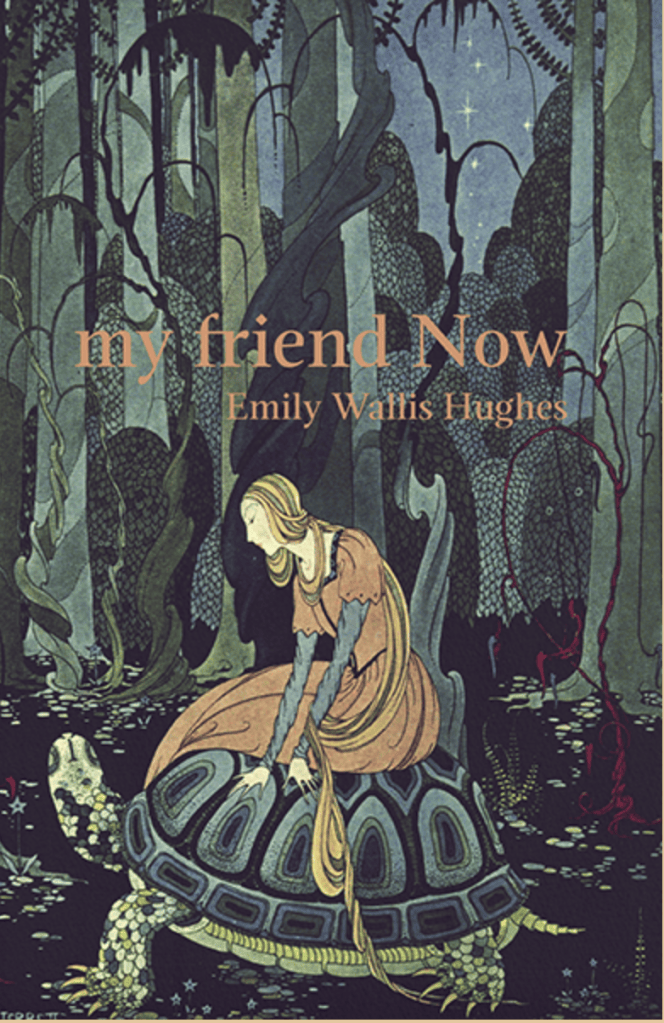
In my friend Now, Emily Wallis Hughes’s second book of poems, “the self-portrait / is a point of departure / It is everyday life.” With a radical receptiveness to the natural and metaphysical realms, Hughes finds answers she wasn’t looking for, and reports back: “Now I think time itself / really / could be the avant-garde.” Hughes introduces us to many of her mentors, muses, and friends along the way. From Marina Tsvetaeva, Alejandra Pizarnik, Paul Celan, and Lorine Niedecker to contemporary poets such as Rebecca Wolff, Lee Ann Brown, Edmund Berrigan, Julie Ezelle Patton, and Joanne Kyger, Hughes finds a trove of wisdom to guide her search for meaning in a world continually under attack. Kyger’s words, in a visit with Hughes at her house in Bolinas, California, uncover a path forward: “it’s okay not to know.”
my friend Now invites us to listen to our strangest, most paradoxical intuitions and to not turn away from the Odd. This is where the Real lives: the Observatory of the Mind-Heart, the ‘Now’ conceived as a friend.
/\/\/\/\/\
“Emily Wallis Hughes’ my friend Now makes vulnerable connectedness from the material of we mere humans in earthly environment, rendering it normal, natural, abundant. This nectar of intimacy is like breathing, full with the potential for ease, should we want it. Has it ever been so told? my friend Now is a beautiful celebratory human animal book that invites us with courage, complexity and confidence to, alongside the poet, “live in a place / like this now.” — Rachel Levitsky
“The wonderful poems contained within my friend Now show how, if you are the right poet, the process of quietly taking stock of your immediate surroundings can lead to the most stunningly beautiful and profound observations. Emily Wallis Hughes has created a new, superhuman floriography, suffused with generosity and loving kindness, bursting with viridescent abundance.” – Susie Timmons
“The newest collection by Emily Wallis Hughes, my friend Now, is full and alive with all the best creatures: bees, moths, mountain lions, a bald cypress, a heron, an injured black bear, clouds in the form of dogs, Emily Dickinson in the form of a hawk, apple blossoms turning into hands, gentle goslings. These poems remind me that every inch of the earth is alive with pain and complication and questioning and revelation. They feel a little like invitations to share a place both lonely and thrilling, as in Hughes’s poem “Portions to Share in this Almost Season” where we travel to “a small volcanic island, in the middle / of a salty lake encircled / by a sage-filled desert.” And after I’ve read them, I am filled with the sinking feeling I’m about to suddenly and unexpectedly lose something, a limb, a bone, my youth, my friends. Though I may end up becoming something delightful in transformation, as in, “wild! / berries at a party / in an abandoned mine.” – Kiik Araki-Kawaguchi
“Can we “…find a place outside commodification of the soul”? my friend Now lets us know it is no easy task, but it’s doable. Emily Wallis Hughes is a generous poet, giving us a clear eyed view of her process and the period of gestation these poems needed to take their bounded form. Joanne Kyger, whom Hughes had a personal relationship with, informs the long poem “Mango Lemonade.” Kyger, famously open to meeting & guiding younger poets from her residence in Bolinas, California, informs Hughes, “it’s okay not to know”; this is a guiding mantra of my friend Now. In the dream of this life, there are many sunsets, and with a poetry committed to the deep image, Hughes knows it will take the casting of just as many spells for each of us to weave together the knowledge we’ve gathered to form a meaningful manuscript and a life—to go both outside ourselves and to plumb the depths within.” — Jeffrey Joe Nelson
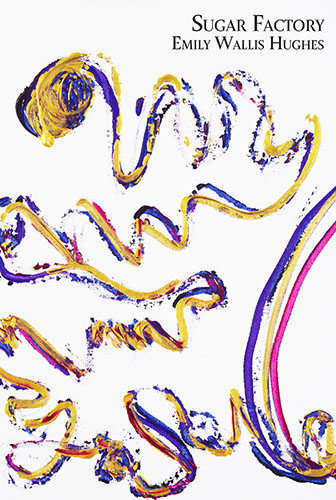
Emily’s first collection of poems, Sugar Factory, including a series of twelve new acrylic paintings by Sarah Riggs in collaboration with Emily’s poetry, and a co-written essay in two colors by the poet and artist about their collaboration, was published in January 2019 by legendary small press Spuyten Duyvil. Order a copy here, or find it at your local bookstore or library. Sugar Factory was a finalist for both the Fence Modern Poets Series Prize and the Tupelo Press Dorset Prize.
“Sugar Factory is absolutely
gorgeous lyric fire.”
“These poems make me so glad. I don’t think I’ve ever seen such a charming use of the exclamation point. And there is such a vastness to these little poems — the way Joanne Kyger or Larry Eigner were able to write like brushstrokes — Emily Wallis Hughes lives fully, sensually in the natural world, in the city, and in a family’s past. You will feel so at home in these poems; they are a tonic.” – Matthew Rohrer
“Sugar Factory glows with a glorious haunting, dwelling deep inside the language of listening and attention. Ancestors, predecessors, and material textures transmit in exclamatory abundance the anxiety of time passing. Lines such as “your green stays green” and “how am I?/ to end this poem” beautifully capture an attempt to hold on to fleeting impermanence. The book delights in expectancy as it flows effortlessly from generation to generation, across continents, and makes a gift of embodiment to each of its varied speakers allowing for the ecstatic possibility to “leave one’s body and return.” Reading Sugar Factory one is struck simultaneously by the resilience and slippage of memory as it weaves in and out of fragmented storytelling while also asking: what is it that this telling gets done, what of memory’s remains does one have to contend with, and what is it to speak towards someone who is no longer alive. As “This I” continues to shift and redefine itself, the reader soaks in the pleasure of being a ready recipient moving both towards specific familial pasts and a dreamlike unreality as each environment evoked leaves a trail of meditative intimacy.” – Anna Gurton-Wachter
“Like Whitman’s “Song of Myself,” Hughes’s Sugar Factory is a laud for the land, a deep song of praise for the ecstasy in the ordinary. Riding the train, peeling fruit, contemplating streaks of color—here we find everyday encounters opening doorways to memory, both intimate and ancestral. The result is a quietly fierce collection of poems that spans coasts and continents as it boldly “carries the voices of the living/and the dead.”’ – Patricia Killelea
“Emily Wallis Hughes’s poems are an absolute joy to read. As a fellow poet—and a fellow Californian—I greatly admire her keen ability to evoke a sense of place. She has that essential gift of making one feel totally immersed in the world of her poems—and of conjuring in the reader a sense of delicious and aching nostalgia for things not in the reader’s experience. With its light touch and its exceptional range of techniques, voices, and registers, Sugar Factory is a treasure.” – Geoffrey Nutter
Read critic Greg Bem’s review of Sugar Factory in Yellow Rabbits here.

